
The California Air Resources Board (CARB) has led the way in reducing hydrofluorocarbon (HFC) emissions. These are a class of long-lasting greenhouse gases widely used in refrigeration, air conditioning and other industrial applications. The phasedown regulations are now in effect, prompting California businesses to get up to speed on compliance requirements.
A clear understanding of the compliance requirements and available funding programs is crucial for food retail, industrial cold storage and food and beverage processing facilities as they move forward.
Ben Rosenzweig, PE, Division President, CoolSys Professional Solutions, offers his expert insight in the Q&A below.
Please provide a high-level overview of CARB regulations and their relationship to the HFC phasedown.
Ben: CARB’s F-gas Reduction Incentive Program (FRIP) was developed in California after state leaders recognized that transitioning to ultra-low-GWP (global warming potential) refrigerants is a costly but necessary step for the environment.
Current rules state that companies owning 20 or more stores in California, with equipment containing 50 pounds or more of refrigerant in at least one system, would need to attain a companywide weighted average GWP of less than 2,500 or demonstrate a 25% reduction in greenhouse gas potential below 2019 levels by December 31, 2026.
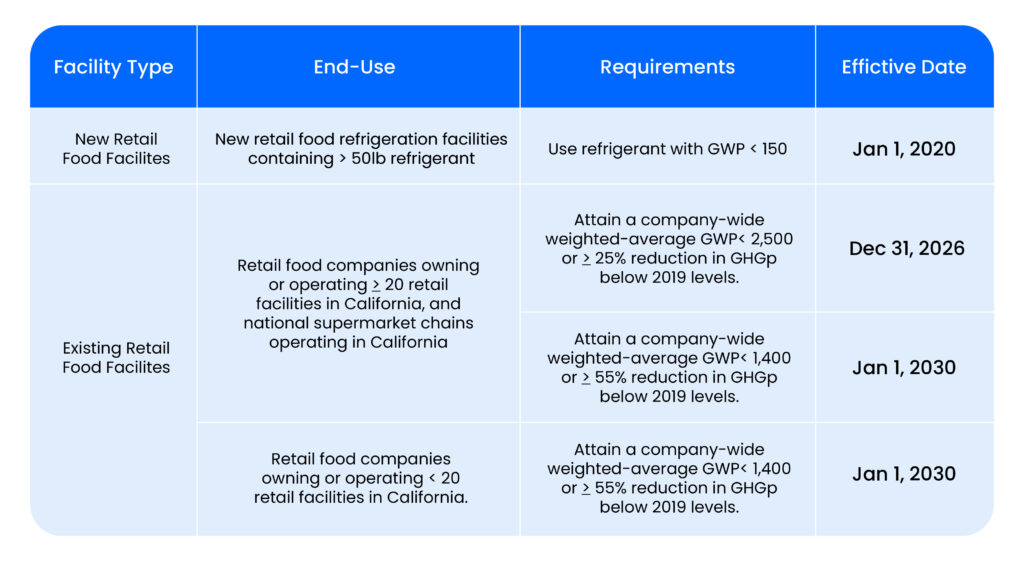
Companies owning fewer than 20 stores will need to comply with similar requirements—a GWP weighted average of less than 1,400 or a 55% or greater reduction in greenhouse gas potential emissions by January 1, 2030.
These are aggressive goals that will be very costly for retail and other refrigerated space owners. Thus, the state introduced an incentive program—FRIP—funded by $45 million to help owners transition to ultra-low-GWP refrigerants.
Are the CARB regulations more restrictive than what we’re seeing on a federal level?
Ben: CARB’s regulations are stricter than or in line with some of the EPA’s federal regulations. However, in California, almost all the trigger dates are earlier.
Federally, the Technology Transition Rule—part of the AIM Act—was finalized. The triggers for this start over the next couple of years for different types of equipment and systems, with varying GWP limits ranging from 150 to 300, and 700 for HVAC systems. The federal rules are as strict as CARB regulations, and they’ll be challenging to adopt. However, they don’t include enterprise-wide weighted average GWP requirements that will force retailers to undertake retrofit and replacement projects across their entire network of sites and assets throughout the state of California to comply with the deadlines that come due in 2026.
What should clients know about the process for applying for FRIP funding?
Ben: First, the company must be eligible to apply.
California-based facilities with 50 pounds of high-GWP refrigerant in at least one refrigeration system are eligible to apply. The applicant and facility must also be registered under CARB’s Refrigerant Management Program (RMP) and comply with all the associated federal and state laws, including RMP and HFC regulations.
Please note that there is no longer a minimum refrigerant charge requirement, which is a change from earlier versions of the FRIP guidelines.
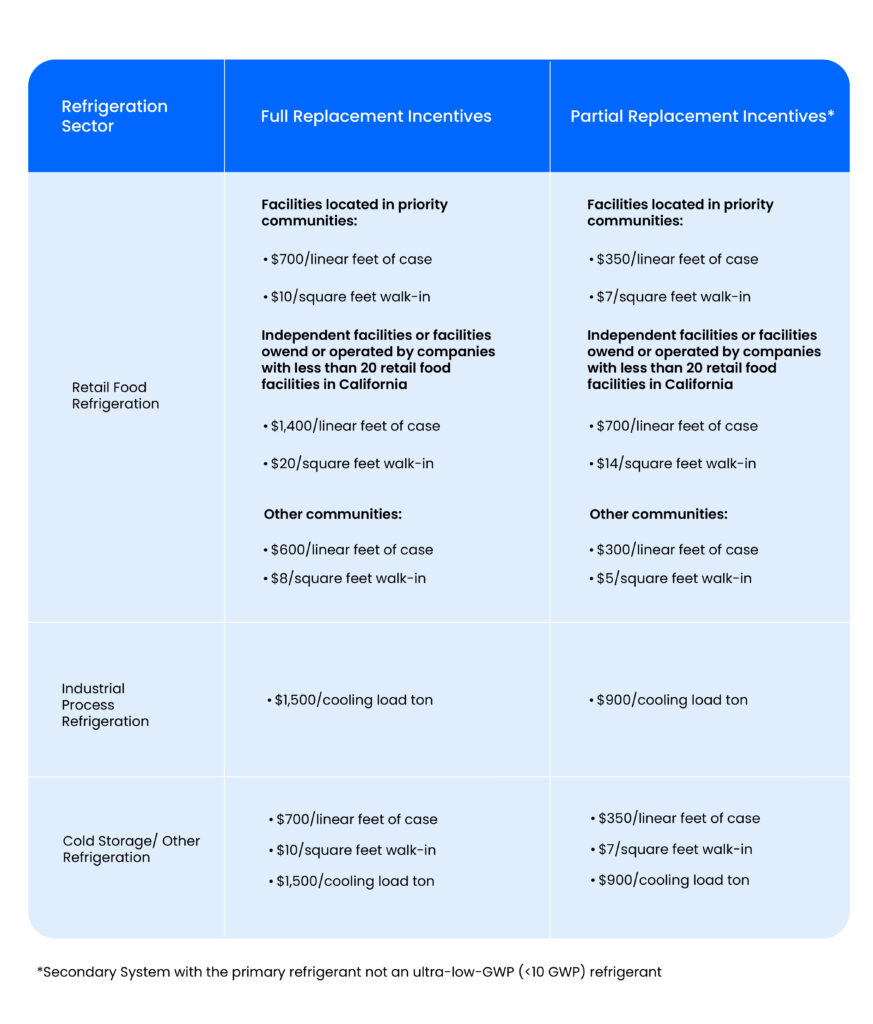
Eligibility to apply is grouped into three sectors:
- Retail food refrigeration,
- Industrial process refrigeration, and
- Cold storage and other refrigeration.
The minimum GWP for all existing systems to be replaced is 1,300 for all three sectors.
If you meet these minimum requirements, it is worth checking the FRIP guidelines for eligibility criteria and other recent changes. You can also go to the FRIP funding website to create a profile and apply.
What are some key dates for applying?
Ben: The current application period closes March 31, 2026.
It’s important to note that funding is provided on a first-come, first-served basis. Applicants also must confirm that projects will be completed, in terms of execution in the field, by April 1, 2027. That’s also the deadline to submit a reimbursement request. Applicants who meet these criteria can expect their payments for approved reimbursement requests by June 30, 2027.
Please note that this program doesn’t provide upfront funding to support your project. It’s intended to provide assistance and reimbursement for executing the actual project. This ensures the program’s goal of positively impacting the climate and reducing greenhouse gas emissions.
How much money can approved applicants expect to get for their site? What’s the breakdown, and does it vary by sector?
Ben: The incentives will differ by sector and scale with the size and scope of the replacement. Higher incentives are offered to facilities located in priority communities and independently owned and operated food retailers, as opposed to mass merchants with multiple sites throughout the state or country.
By sector, there are full replacement and partial replacement incentives. Those are designated for retail food refrigeration based on linear feet of cases being replaced or dollars per square foot of walk-in coolers and freezers. If you’re located in a priority community, the incentive rates are higher per linear foot or square foot.
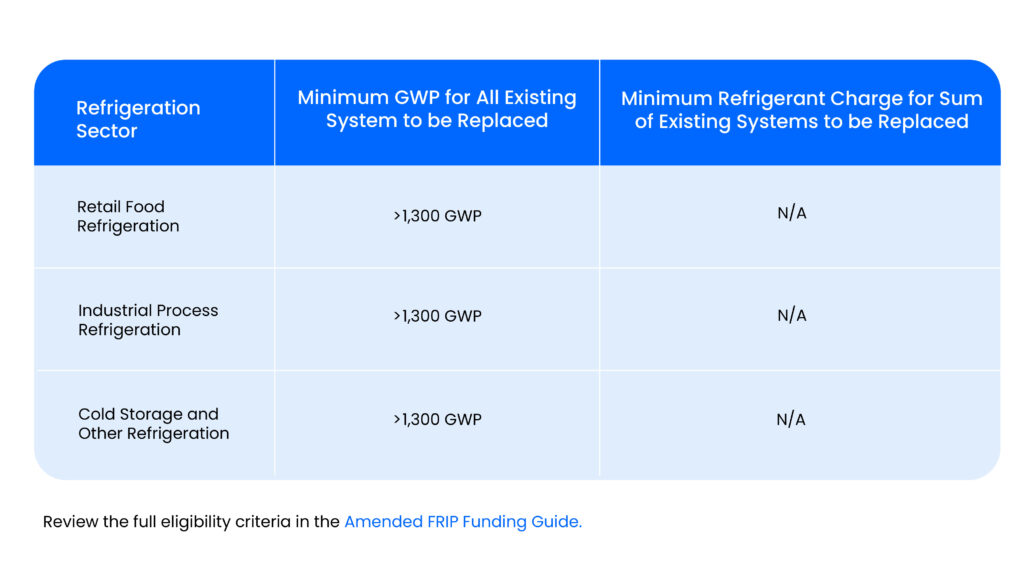
Incentives for industrial process refrigeration are $1,500 per cooling load ton for a full replacement and $900 per cooling load ton for a partial replacement.
How do you integrate environmental goals, such as reducing greenhouse gas emissions, into design and engineering?
Ben: At CoolSys, we consider the environmental impact of the systems we’re designing for new construction and retrofit projects in several ways.
The systems we design—whether they’re MEP, refrigeration or other building systems—have multiple sources of emissions in the environment, namely Scope 1 and Scope 2 emissions. This refers to direct emissions at the building (Scope 1) and indirect emissions from the power plants that provide or produce the electricity for your building (Scope 2).
Our CoolSys experts like to view it through the lens of the owner in terms of what drives them, and through the lens of the regulations. We examine the project and propose system designs that meet the minimum requirements of regulations, and hopefully exceed them.
For instance, CO2 (R-744) has a refrigerant has a GWP of 1. It’s essentially future-proof when it comes to federal and state GWP limits of 150, 300 or higher. We can help you understand how to transition to ultra-low-GWP refrigerants like CO2, propane (R-290) and other natural refrigerants. However, many solutions can help you achieve your goals with the capital you have available. We consider all of these facets to help you understand the best solution for your individual project.
Are there any emerging technologies or innovations in refrigeration that will really benefit the HFC phasedown requirements?
Ben: Today, there are many solutions that end users can consider in terms of technologies and system types when it comes to low-GWP refrigerants. While CO2 and hydrocarbon refrigeration systems have been in use for quite some time, technology has undergone significant evolution. The ability to implement a transcritical CO2 or cascade system with CO2 as a secondary refrigerant can be thought of through a new lens.
In terms of securing funding through the program, designing the system and determining the type of equipment available for retrofit projects and new construction, this opens up a more solution-based approach to solving those problems. Manufacturers continue to innovate in terms of equipment size, scale and performance. We’re happy to be in a position where we have numerous solutions on the table for almost every type of store format and system out there.
As California continues to lead the charge in climate action, companies that proactively adopt eco-friendly technologies and phase out HFCs will be better positioned to thrive in a low-carbon economy. Now is the time to assess, adapt and leverage compliance opportunities for a greener, more sustainable future.
CoolSys Is Your FRIP Funding Application Partner
CoolSys is uniquely positioned to help retailers, owners and others with refrigerated facilities and equipment in California apply for FRIP funding. CoolSys is not only an HVAC and refrigeration service and installation contractor, but also an engineering expert in the design of low-GWP systems.
CoolSys understands the program’s implications for your refrigeration equipment and can help you maximize the benefits of the program.
To learn more about how to transition to CO2 refrigeration systems and beat the March 31, 2026, FRIP application deadline, contact CoolSys today!